Monday, April 4, 2011

Tool Lust


What is the tool you covet the most? 
Why? What would you do with it if you got it? 

cov·et : To wish for longingly.

This month’s EtsyMetal Blog Carnival** question reminds us of the old joke about the dog chasing after a car. The punch line being, what would he do with it if he caught it?

We’re like that with tools.  You see, like most of our metalworking friends, we are unabashed tool junkies. So, the tool we covet the most is the one (any one) we don’t have. Who knows what we would do with it once we got it (whatever “it” is). Who cares!

This is really all about tool lust. And don’t pretend you don’t know what we’re talking about. It doesn’t matter what you’re into, you’ve experienced tool lust at some point. Example: We were on one of our exploratory trips into the bowels of Los Angeles some weeks back. There are some truly amazing nooks and crannies to be found in any large city. In little Tokyo we stumbled into a Japanese specialty hardware store.  Is Japanese hardware so different from hardware anywhere else? Apparently so!

Once inside the door of the little shop, we were courteously greeted by the owner. So un-Home Depot like. Our gaze became quickly distracted by floor to ceiling shelves overloaded and bristling with tools of unimaginable functions.  This was way better than a trip to Disneyland, and clearly had the potential to be far more expensive.

We beckoned to the store owner. We were going to need an experienced guide on this safari.  For the next hour and a half we grilled this patient little man on the detailed operation and purpose of almost the entire contents of his store. Some tools were so specialized and esoteric that their purpose couldn’t be communicated by the shop keeper’s limited English and Kafkaesque pantomime. No matter, it seemed we were destined to get at least one of everything.

The shop keeper led us into the dark and cluttered rear of the store. With a quiet knowing smile he descended behind a counter. When he reappeared he held an object in his outstretched hands, which he offered to us almost reverently. It was a pair of scissors. We gently took the cutting implement from the shop keeper. This was no ordinary pair of scissors.  “For bonsai” said our host, “finest in all Japan”, as he motioned like Edward Scissorhands for effect.  Indeed, they were exquisite in their utilitarian plainness, clearly handmade, and razor sharp.  There was no way we were leaving that store without those scissors.

Which brings us back to the story of the dog chasing the car. We don’t do bonsai, but we have one hell of a good pair of bonsai scissors.

** This series is part of "Blog Carnival" a project of EtsyMetal. Each month, members of EtsyMetal share thier views on a common theme.

EtsyMetal is an International group of metalsmiths who create handmade Jewelry. More information about the group and it's members can be found at http://www.etsymetal.com

Saturday, March 5, 2011

What jewelry do jewelers wear?

You’re a jewelry designer, but what kind of jewelry do you wear? This is always an interesting question to pose to artists in any medium, eg: What music do musicians listen to? The question presupposes an insider’s refined sensibility, as well as a knowledge of, and appreciation for artists that may be beyond the public taste.

Full disclosure: Corliss wears lots of jewelry, all the time. John almost never wears jewelry. Both of us actively collect the work of other artists.
We have an extensive collection of tribal and ethnic jewelry that has been assembled from our travels around the world. We also have an extensive collection of contemporary work assembled through contact with our fellow artists.

We can’t point to any particular piece and say “that’s our favorite”. We love them all. That is why we own them. Which pieces are worn at any particular moment is dictated by mood and what is appropriate for the venue, look and/or statement we want to make. We have a very broad palate to choose from.

So, here is a peek at a small selection of the contemporary jewelry that Corliss has worn in the last few weeks.

Left: A Penny Harrel necklace. This was acquired in a trade with the artist for one of our pieces. Our favorite way to add to the collection.


Below: Earrings by Tamara. We actually bought these about 20 years ago. They are extremely well made and have held up well both mechanically and stylistically.


Left: A wonderful alluminum necklace by Vanessa Waliko that was acquired at the 2010 SNAG Conference.


Below: A wonderfully industrial chain link bracelet from an unknown French Canadian artist purchased in Quebec many years ago. Wish this artist would have signed the work. Note: I this is you, or you know who made this, let us know.


Left: A Robert Lee Morris pin. This was a gift from Robert. We worked with him on a fashion show and retrospective of his work held at the Los Angeles County Museum of art.


Below: A pair of Jillian Moore earrings. These were a recent right place at the right time acquisition. We happened to be on-line when Jillian posted that these were up for sale. We snapped them up. Lucky us.


Left: Harriete Estel Berman earrings. We had to have these. The reference to traditional jewelry was too funny and ironic to pass up.

Below: a traditional Scottish pin form from the master Greg Thorne


Left: A heavy silver and Mexican fire opal bracelet by Dana Gochenour. Dana is one of our prospecting buddies and is a first rate geologist and miner, in addition to being an accomplished jeweler.

Left: An amazing brooch by Don Friedlich. This piece is made of frosted glass and refracts any thing that it is placed on. It is a real joy to wear as it optically changes as you move.


Left: An iconic piece that we commissioned from Lorena Angulo, a master of precious metal clay. We were in love with the designs and style of Lorena's work and asked her to make something using silver, bronze and copper clay in one piece. No one had done this before and it turned out to be quite learning curve. Lorena pulled it off spectacularly.

Below: One of our own pieces from back in the day when we were making more traditional jewelry forms. 52cts of matched rubellite tourmaline set in gold. We mined, cut and set the stones and couldn't bear to sell it.


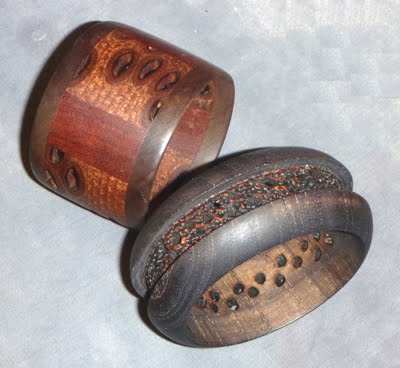
Left: A pair of wooden bracelets from one of our collaboration partners, wood turner Chet Brisco. The top piece is turned Banksia pod, cocobolo and walnut. The bottom piece is turned and textured with pyrography.


** This series is part of "Blog Carnival" a project of EtsyMetal. Each month, members of EtsyMetal share thier views on a common theme.

EtsyMetal is an International group of metalsmiths who create handmade Jewelry. More information about the group and it's members can be found at http://www.etsymetal.com

Saturday, February 5, 2011

So, what else do you do?

Most creative people we know express themselves in many different media and forms. It is just the nature of the creative mind to find outlets for that creativity. We are no exception, which leads us to the topic of this month’s Blog Carnival*:

What other media do you work and play with? Does it relate to or inspire your metalworking?

When this topic came up, we had to stop and really think about it. We have both been working artists from childhood and everything we touch, everything we do, becomes an art project. Our entire life is one big art project. We can’t help ourselves.

As to whether any of these activities relates to, or inspires our metalwork; it is all a continuum to us. We see no difference in any of it other than the medium of expression. This topic is really about another subject that artists frequently deal with, namely, the idea that art is a job or vocation. For most of us it is a way of life, and it permeates every aspect of our lives.

The best way to explain this is to show you a random selection of images of some of the things we do. Some of the following is work made for sale. Other things are simply random acts of creativity for our own use and amusement. This is life on the art side.


We have worked in glass in its various expressions for may years. Stained glass work is our favorite, but we've been blowing glass of late. The cow jumping over the moon window is in the west wall of our house. Below are a couple of recent glass blowing attempts. The goal is to work this down to the micro or jewelry level.


We also do woodworking of various sorts ranging from furniture to finish carpentry and woodcarving. Most of what we do is commissioned, but we also do a lot of things for our own house. This is an on-going project that we've been working on for decades

.

This is a door to the library, painted in traditional Japanese motifs. Below is a detail of the hand carved door frame.


Here are a few other details from around the house.

Another hand carved door frame detail.


This is a small wood carving that we mounted on the kitchen cabinets under the sink.

We have served as the curators of the local area Historical Museum for decades. When one of the local historical homes was being demolished we have the opportunity to do some salvaging. This corner niche is constructed of 150 year old Mahogany and slate reclaimed from the house.


Corliss is also a professional pastry chef and has done food styling for many tv commercials and restaurant displays.

We frequently turn our attention to fabric, either on its own or for our jewelry.


This is Sharky, our house mascot.

We will even get downright functional, as with these sofa pillows.


When the mood and the season coincide we occasionally go into "wreath mode". We been making these for decades and no two are ever alike.

Many of you know that we both are traditionally trained artists. We both cut our teeth on painting and drawing and continue to work in those mediums as well. In fact we never go anywhere without a sketch book - including dinner. One of our favorite things to do is people watch and draw character sketches and impressions from memory. Over years we have amassed thousands of drawings of everything from biker funerals, raves, Las Vegas madness and art openings.


If you have ever met us, there is a good chance there is a drawing of you somewhere.
One of the challenges of our classical training has been to break free of the rigid representationalism that is imposed in such a system.

We took up jewelry in the first place, as a method to break out of the training of two dimensional representation. That and the fact that we had been prospecting for many years and needed to actually DO something with all the material we were collecting.

This is our little curiosity cabinet. The other 7 tons of material (no joke) is scattered about the property.
In between all of the above we also practice lapidary & gem cutting, photography, writing, antique repair and restoration, leather work and few other things. And there's lots more we want to do and haven't found the time to get to it yet - but we will.

** Blog Carnival is a monthly group project of EtsyMetal. Each month, members of the group write on a common topic. Readers can click on the links associated with the topic to see how different artists approach it.


Saturday, December 18, 2010

Do You Do Custom Orders?

This month’s Blog Carnival* question is: Do you take custom orders? What kind of custom work do you do or not do? What has been your favorite custom piece?

The short answer is, yes. We do a lot of custom orders, typically utilizing things that people bring us that they would like to have incorporated into something they can wear.

This is very satisfying work because the resulting piece usually has deep meaning and personal value for the recipient. It can also be nerve wracking, as we are painfully aware that the material we are working with is irreplaceable – and often unstable, unsuited, and unintended for jewelry use. But, that is also the great creative challenge, to make it so.

Because we are fairly well known within the jewelry field for our ability to work with just about any material, no matter how odd, other jewelers and museums often refer work to us. These projects have included no end of mineral and rock specimens, antiquities and artifacts, old machine parts and mechanical devices, found objects of every conceivable type, food, other jewelry, glasses and lens, computer and electronic parts, weapons, fabrics, liquids, human teeth and taxidermied animals.

Its impossible to identify a “favorite” piece, because each one is a unique part of someone’s life and touches us in different ways. One gentleman brought us his great-grandfather’s watch that had been worn by successive generations of his family through four wars. That watch was beat to shit and looked like it had been through four wars, but you knew that every scratch, nick and dent had a story behind it.

Another client casually dropped by the studio one afternoon and dropped off a bag of artifacts that she had collected over 40 years of world travel. There was stuff in that bag that predated the time of Christ from a wide variety of cultures. And now it was all sitting on our bench. Stuff like this blows our mind when we think of the journey through time and space that these objects have taken.

Yet another project was working with reclaimed parts from a Soyuz space capsule.

That seemed like a souvenir worth having, but terribly difficult material to work with. Who knows what specialized alloy of god-knows-what this stuff was made from. One thing’s for certain, it didn’t work like any metal we have ever encountered before or since.

So, by now, most of you are thinking, “ shut up and show me”. OK. This is a piece we did for one of our long-time collectors. It started as a couple of coins from antiquity, a couple of artifacts, and a request to “make something”.


* Blog Carnival is a project of EtsyMetal, where member artists share their thoughts on a monthly theme.

Read the other blogs to get a broader view of how different artists approach this topic.


Sunday, November 7, 2010

Business Success Secrets for Artists

EtsyMetal Blog Carnival
Each month, the artists at EtsyMetal take a crack at a different topic related to the arts. This month it's Business Success Secrets: What does it mean to you to be "successful" in business as an artist? How do you walk the line between creativity and profitability? What is the best thing you've done for your business?

Artists often wrestle with, and angst over, the question of how to define success. Get a bunch of us together and the conversation on this topic can get hot fast. The main bone of contention usually always boils down to the fact that financial success is often viewed with suspicion and seen as a sign that one’s artistic integrity has been compromised. The converse of this is that many individuals who enjoy an artistic leadership position in our field don’t have a proverbial pot to piss in and cannot support themselves on their art.
The question posed for this month’s blog carnival illustrates this concept: “How do you walk the line between creativity and profitability?” Creativity and Profitability are presupposed as mutually exclusive states. It wasn’t always this way in the arts.
We don’t think that we need to walk a fine line between creativity and profitability. We think that running a profitable business making art REQUIRES creativity. And not just in designing and crafting a product. Business is an art and art is a business.
The truth is, no one does art in any form for the money. It is a calling, a way of life. What we all hope for is to be able to express ourselves through our art in our own pure voice. To make the art we want to make. If this coincides with what people want to buy, you have arrived at artistic Nirvanna.
The best thing we have done for our business is to study business principles and stay true to our artistic principles. For us, success is pursuit of an artistic way of life.

Monday, June 7, 2010

Gods and Mascots

The subject of “studio mascots” came up the other day. Specifically, what / who is your studio mascot(s) and does he/she/it inspire you? Watch you? Encourage you? Impede your work? We suspect the answer being looked for was something along the lines of “our cat HairBall, who’s cuteness inspires us to create things that benefit all mankind”. Well, things don’t quite work that way at 2Roses studio.

Walk into any artist’s studio and look around. Its always a mess, and embedded in that mess are usually all sorts of odd, intriguing, unsettling objects that beg for an explanation. These objects won’t be the projects or work the artist is working on. Rather, they are the population of totemic and symbolic objects that are imbued with great and small personal meaning for the artist. They are often scattered about the studio like small shrines and invariably have a story attached to them. We refer to these objects collectively as the “Studio Gods”. Here are just a very few of the Studio Gods at 2Roses. On a good day the Studio Gods are with us. On a bad day they demand sacrifices.


Godzilla Torch Lighter


Catbird House


Turtle Tom


Hoofy Doo


Uncle Bob


Shark Foot

Wednesday, March 31, 2010


The Creative Process:
How we plan and organize for design.


Our Design Process isn’t really an organized plan but rather a collection of spontaneous moments. When we seize one of them, so to speak, we utilize two primary vehicles to get a concept ready for bench creation.


Our Extensive Library
Over the years, we’ve built an extensive, working library with volumes on technique, full color coffee table gaga, botanical editions, illustrated historical references, children’s books, travel destinations, tattoo designs, ancient armament, you name it. The library serves as a reference for detailed research and study. We’ve solved many technical problems and have received much inspiration after a browse through the library. Keeping it orderly is another matter. It's like the Enterprise being overrun with Tribbles. Our books must be breeding and having offspring.


Our Indispensable Sketch Books

We keep sketch books within easy reach at all times. When we say this we mean that we keep sketchbooks everywhere. Our ideas could be in the form of descriptive text, illustrations from a recent museum exhibit, ideas for a new one of a kind piece or a new line concept. We create this output whenever it strikes us – when’s it’s fresh in our minds.

Once we have some ideas that look good on paper, it’s off to the bench. Sometimes a construction paper model is made before any metal is cut and soldered. Sometimes we go for broke and just fabricate. What really helps us is to keep what Corliss calls a “fragment sample” of a completed piece. These are usually a step by step series of components illustrating how something is textured, formed, finished, joined, etc. We do so many things and work with so many materials that we need to have these reminders around to jog the creative
memory.